def sub1():
    a = 4
    y = 5
    z = 6
    sub2()
    print("In sub1,")
    print('x = %d' %x)
    print('y = %d' %y)
    print('z = %d' %z)
    print('a = %d' %a)

def sub2():
    a = 7
    b = 8
    z = 9
    sub3()
    print("In sub2,")
    print('x = %d' %x)
    print('y = %d' %y)
    print('z = %d' %z)
    print('a = %d' %a)
    print('b = %d' %b)

def sub3():
    a = 10
    x = 11
    w = 12
    print("In sub3,")
    print('x = %d' %x)
    print('y = %d' %y)
    print('z = %d' %z)
    print('a = %d' %a)
    print('w = %d' %w)

x = 1
y = 2
z = 3
sub1()
print("In main program,")
print('x = %d' %x)
print('y = %d' %y)
print('z = %d' %z)
static scoping rule.The parents of sub1, sub2,and sub3 are outside of them.
Output:
In sub3,
x = 11
y = 2
z = 3
a = 10
w = 12
In sub2,
x = 1
y = 2
z = 9
a = 7
b = 8
In sub1,
x = 1
y = 5
z = 6
a = 4
In main program,
x = 1
y = 2
z = 3
Why does it print start from sub3?
dynamic scoping rule,what will be output?
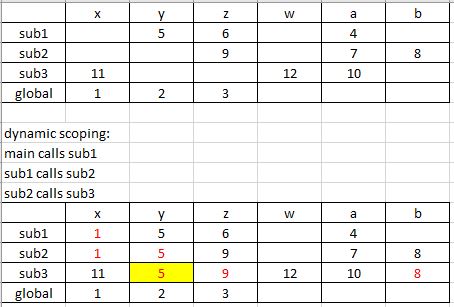
Examples of languages that use dynamic scope include
Logo, Emacs Lisp, LaTeX and
the shell languages bash, dash, and PowerShell.
Dynamic scope is fairly easy to implement (compiler).